X-0 Rules
X-0 is a free-style Gomoku variant without fouls. The simplest and fastest mode. Played on a 15×15 board.
Objective
Be the first to build five or more stones of your color in a row — horizontally, vertically, or diagonally.
Basic Rules
- Black (X) always moves first.
- Players take turns placing one stone on an intersection.
- The first to form 5 or more stones in a row wins.
- No fouls — for either Black or White. Any fork (3×3, 4×4) is legal. Overlines (6+) also count as a win.
Mode Features
- No restrictions on the first move — Black can place a stone on any cell.
- No opening rules — the game starts immediately.
- Recommended for beginners and quick games.
Draw
If the board is completely filled and no player has built 5 in a row — the game is a draw.
Gomoku Rules (Swap2)
Gomoku is the classic version without fouls. All rows of exactly 5 stones win, regardless of color.
Swap2 Opening
Swap2 is the standard tournament opening in Gomoku, designed to eliminate the first-move advantage. It consists of two phases.
Phase 1: Placement (Placer)
The first player (Placer) places 3 stones anywhere on the board:
- 2 black stones (X)
- 1 white stone (O)
Phase 2: Choice (Chooser)
The second player (Chooser) picks one of three options:
- Play Black: takes X, opponent gets O. Black makes the next move.
- Play White: keeps O, opponent gets X. Black makes the next move.
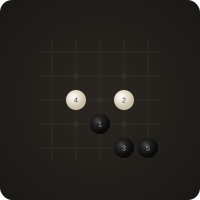
- Add 2 stones: Chooser places 1 more black + 1 more white (5 total on board), then Placer chooses the color.
After the Opening
Standard Gomoku rules apply: 5 stones in a row = win. No fouls. Rows of 6+ stones do not count as a win.
Why It Works
Swap2 motivates the Placer to create a maximally balanced position: if the initial placement favors Black — Chooser takes Black. If it favors White — Chooser stays White. If perfectly balanced — add 2 more stones and return the choice.
Renju Rules (Taraguchi-10)
Renju is the professional version with fouls for Black and the complex Taraguchi-10 opening (5 phases).
Renju Fouls
Black is forbidden: 3×3, 4×4, overline (6+). White plays without restrictions.
Taraguchi-10 Opening (5 Phases)
Phase 1 — First Move (Black)
Black places the first stone exactly in the center (7,7). The opponent may swap colors.
Phase 2 — Second Move (White)
White places the second stone within the 3×3 square around the center. The opponent may swap colors.
Phase 3 — Third Move (Black)
Black places the third stone within the 5×5 square around the center. This creates one of 26 canonical openings. The opponent may swap colors.
Phase 4 — Fourth Move (White)
White places the fourth stone within the 7×7 square around the center.
Phase 5 — Fifth Move (Black)
Black has two options:
- Choice 1 (Normal): Black places one 5th stone within the 9×9 square. Opponent may swap colors. White makes the 6th move.
- Choice 2 (Taraguchi-10): Black waives all swap rights and places 10 candidate 5th moves (no symmetrical duplicates). White chooses one and removes the other 9. White then makes the 6th move.
How It's Implemented on X-0
The Taraguchi-10 opening is implemented with visual guidance at each step:
- The system highlights valid zones for each move (3×3, 5×5, 7×7, 9×9).
- The Swap button lets you switch colors during phases 1-4 and Choice 1 of phase 5.
- In phase 5 Choice 2 (Taraguchi-10), an interface appears for placing 10 candidate moves.
- White sees all 10 candidates and selects one by clicking.
Game Basics: Threes, Fours, and Forks
In Gomoku and Renju, simply building rows is not enough — you must create double threats that your opponent cannot block simultaneously.
Threes
Open Three — three stones in a row with both ends free. This means on the next move it can become an open four (which wins from either end).
Closed Three — one end is blocked by an opponent's stone or the board edge. Not a serious threat.
Fours
Open Four (Straight Four) — four stones, both ends free. The opponent cannot block it: if they close one end, you complete from the other. This is a guaranteed win.
Closed Four — four stones with one free end. The opponent must block that end, otherwise you win next turn.
Forks
A fork is a move that simultaneously creates two threats. The opponent can only block one, and you win with the other.
- 4×3 Fork — one four + one open three. The most reliable and common winning combination. The only legal fork for Black in Renju and X-0.
- 3×3 Fork — two open threes. Forbidden for Black in Renju and X-0. White may use it.
- 4×4 Fork — two fours. Forbidden for Black.
Strategy
- Threat priority: a four beats a three. If your opponent has a four, you must block it even if you have a fork prepared.
- Fork preparation: do not play the winning fork immediately — first prepare the position by placing supporting stones.
- Fork defense: watch for your opponent's potential fork points and occupy them preemptively.
- Using fouls: White can deliberately create positions where Black is forced to make a forbidden move (a trap).
Ratings
X-0 maintains a separate ELO rating for each game mode: X-0, Gomoku, and Renju.
How ELO Works
The ELO rating measures a player's relative strength. After each game, ratings are recalculated based on the result and the rating difference between opponents.
Formula
Expected score: EA = 1 / (1 + 10(RB − RA) / 400)
New rating: R′A = RA + K × (S − EA)
Where:
- RA — player's current rating
- RB — opponent's rating
- S — actual result: 1 (win), 0.5 (draw), 0 (loss)
- K — development coefficient
K-Factor
K determines how much the rating changes after a game:
- K = 64 — new players (less than 10 games in the mode). Fast calibration.
- K = 32 — players rated below 2000.
- K = 24 — players rated 2000–2299.
- K = 16 — players rated 2300+.
Example
Player A (1500, K=32) vs Player B (1500, K=32):
- Expected score: 0.5 (equal strength)
- A wins: +16 points (1516)
- Draw: 0 points (1500)
- A loses: −16 points (1484)
With a 200-point gap (1700 vs 1500): the stronger player gains +8 for a win, the weaker gains +24 for a win.
Ratings Per Mode
Ratings do not carry over between modes. You can have 1800 in X-0, 1550 in Gomoku, and 1620 in Renju — three independent ratings. Starting rating in each mode: 1500.
Tournaments
X-0 hosts regular and player-created tournaments across all three game modes.
Tournament Types
- Regular Tournaments — auto-created on schedule. Open to everyone.
- Player Tournaments — created by players. Can set a password for access.
Formats
- Round-Robin: everyone plays everyone. Used with ≤8 participants. Rounds = N−1.
- Swiss System: pairs matched by score. Used with ≥9 participants. Rounds = ⌈log₂(N)⌉ + 2.
Participation Types
- Individual: every player for themselves.
- Team: teams (clans) compete. The captain assigns players to boards.
Tiebreak Coefficients
- Buchholz: sum of opponents' scores.
- Berger: sum of defeated opponents' scores + half the score of drawn opponents.
- Progress: sum of cumulative scores after each round.
Regular Tournament Schedule
| Name | Mode | Control | Time |
|---|
| X-0 Tuesday | X-0 | 3+2 | Tuesday 21:00 |
| X-0 Thursday | X-0 | 5+3 | Thursday 21:00 |
| X-0 Sunday | X-0 | 2+1 | Sunday 21:00 |
| Gomoku Monday | Gomoku | 3+2 | Monday 21:00 |
| Gomoku Wednesday | Gomoku | 5+3 | Wednesday 21:00 |
| Gomoku Saturday | Gomoku | 7+2 | Saturday 18:00 |
| Renju Friday | Renju | 5+3 | Friday 21:00 |
| Renju Sunday | Renju | 10+5 | Sunday 14:00 |
How to Participate
- Go to the Tournaments page (button in the left panel).
- Select a tournament and click Join.
- Wait for the tournament to start. The system auto-generates pairings.
- Play your games. Results are tracked in the standings table.
- After all rounds, final standings are published.
Creating Your Own Tournament
On the Tournaments page, click Create Tournament. Set the name, mode, time control, and type. Optionally set a password for a private tournament.
Lessons
The Lessons section allows a trainer to conduct interactive lessons with students on a shared board.
How It Works
- The Trainer creates a lesson — a unique 6-character code is generated.
- Students join the lesson using the code.
- Everyone sees the shared board. The trainer moves — students observe.
- Built-in chat for text communication.
- Audio relay: the trainer can enable their microphone; students hear their voice.
Trainer Capabilities
- Move on the board: the trainer places stones; students see changes in real time.
- Switch branches: navigate between variations in the move tree.
- Write comments: add explanations to each move.
- Audio: enable/disable microphone, select device, adjust gain.
- Chat: text communication with all participants.
- End lesson: the trainer can finish the lesson at any time.
Student Capabilities
- Watch the board: students see all of the trainer's moves but cannot place stones.
- Listen to audio: hear the trainer's microphone.
- Chat: ask questions via text.
Visibility Types
- Open Lesson: anyone can join with the code.
- Closed Lesson: a password is required to enter.
How to Create a Lesson
- Go to the Lessons page.
- Click Create Lesson.
- Choose the mode (X-0, Gomoku, Renju) and visibility type.
- Share the code with your students.
How to Join a Lesson
- Go to the Lessons page.
- Enter the 6-character lesson code and press Enter.
- If the lesson is closed — enter the password.
🧩 Puzzles
The Puzzles mode is a tactical trainer. You are given a board position and must find the winning sequence of moves.
How it works
- Select the ruleset (X-0, Gomoku, or Renju) and set the maximum difficulty level (1–6) using the slider.
- Click Start Solving — a random puzzle matching your filters will appear on the board.
- Make your move by clicking a cell. If the move is correct, the forced response of the opponent is placed automatically.
- If the move is incorrect, you can Try Again (same puzzle) or go to the Next Puzzle.
- Complete all moves correctly — Congratulations! Puzzle solved!
Difficulty levels
Difficulty is determined by the number of half-moves in the solution:
- Level 1: up to 2 moves
- Level 2: up to 4 moves
- Level 3: up to 6 moves
- Level 4: up to 8 moves
- Level 5: up to 10 moves
- Level 6: 11+ moves
The slider sets the maximum difficulty — puzzles of that level and below may appear.
Notes
- You always play as the attacking side (the one delivering the winning combination).
- The database contains 13,500+ puzzles (~4,500 per ruleset).
- Pressing Next Puzzle loads a new random puzzle immediately with the same filters.
- Changing the ruleset or difficulty during a puzzle resets the board.